Ada Lovelace: The First Programmer

Loading story...

A young girl studying mathematics by candlelight in a grand Regency-era drawing room
1815–1828 England

Daughter of a Poet, Raised by Numbers

Augusta Ada Byron was born on December 10, 1815, the only legitimate child of the celebrated and notorious Romantic poet Lord Byron. Her parents separated when she was a month old, and Lord Byron left England forever shortly after—she never knew him. Her mother, Anne Isabella Milbanke, was herself highly educated and deeply wary of her husband's volatile temperament. Determined that Ada would not inherit what she called the "Byron madness," she arranged an unusually rigorous education for her daughter, centering it on mathematics, science, and logic. It was an extraordinary upbringing for any child of the era, and especially for a girl.
A teenage girl working through geometry proofs at a writing desk surrounded by mathematical texts
1828–1833 London, England

An Education Unlike Any Other

Ada's formal education in mathematics was virtually unheard of for women in early nineteenth-century England. Her mother hired a succession of distinguished tutors, and Ada herself proved a passionate and tenacious student. At age twelve she conceived an ambition to fly, methodically studying birds and experimenting with materials before attempting to design mechanical wings. At seventeen she began studying under the celebrated mathematician Mary Somerville, one of the first women admitted to the Royal Astronomical Society. Through Somerville, Ada was introduced to London's scientific and intellectual circles at precisely the moment they were buzzing with a remarkable new invention.
A young woman examining a mechanical calculating machine in a gentleman's workshop, accompanied by an older inventor
June 1833 London, England

Meeting Babbage, 1833

In June 1833, Mary Somerville brought Ada, just seventeen years old, to a demonstration at the home of mathematician and inventor Charles Babbage. There, Ada encountered a partial prototype of Babbage's Difference Engine—a mechanical calculator of extraordinary complexity, designed to compute mathematical tables automatically and eliminate the human errors that riddled the printed tables then relied upon by navigators, engineers, and scientists. While the other guests admired its brass gears and columns of numbers, Ada grasped its deeper implications. Babbage, twenty-four years her senior, recognized a rare mind. A correspondence and collaboration began that would last the rest of her life.
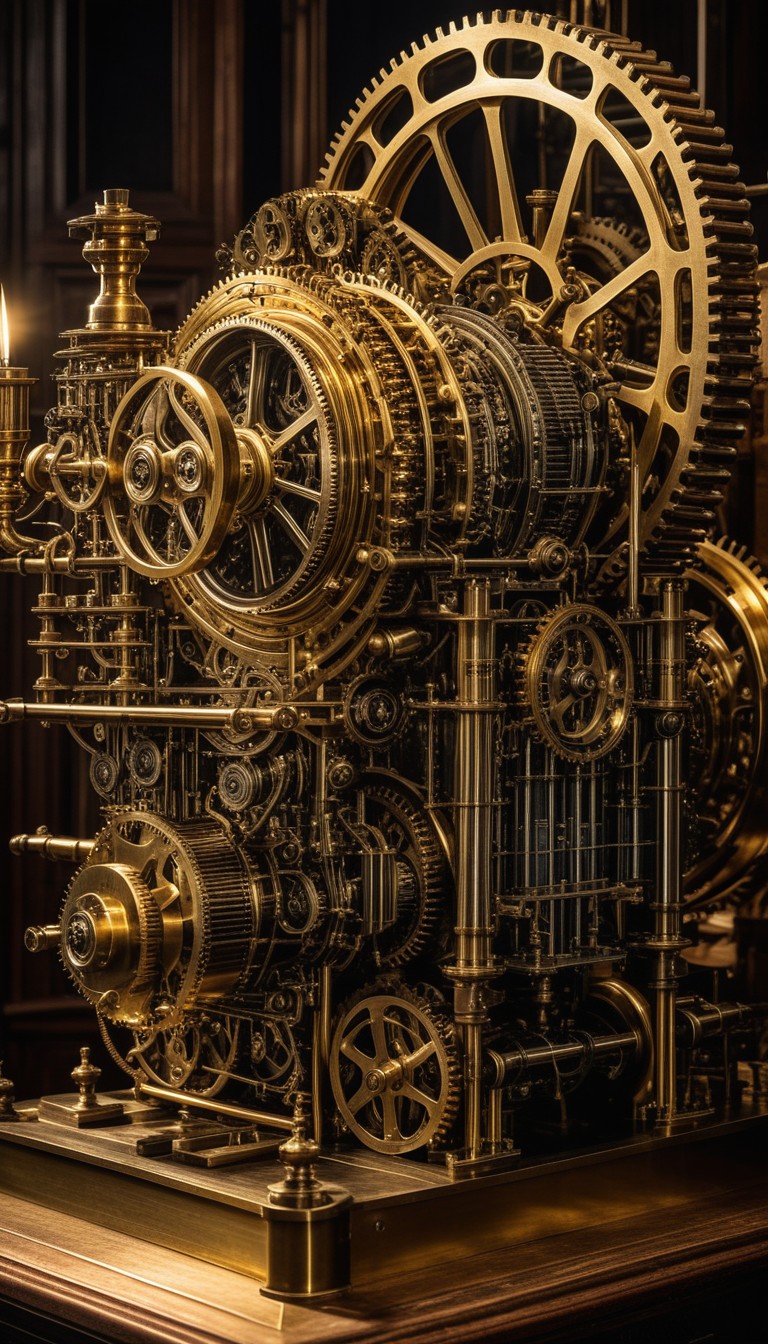
Detailed engineering drawings of a massive mechanical computing engine with thousands of interlocking gears
1837–1842 London, England

The Analytical Engine

By the late 1830s Babbage had set aside the Difference Engine and turned to an even grander vision: the Analytical Engine. Unlike its predecessor, which could only perform a fixed sequence of calculations, the Analytical Engine was designed to be programmable. It would have a "mill" for computation and a "store" for memory, accepting instructions via punched cards—a concept borrowed from the Jacquard loom used in the weaving industry. In essence, Babbage had conceived the architecture of a general-purpose computer. The British government, already having poured funds into the unfinished Difference Engine, refused further support. The Analytical Engine was never built in Babbage's lifetime, but Ada understood what it meant better than almost anyone.
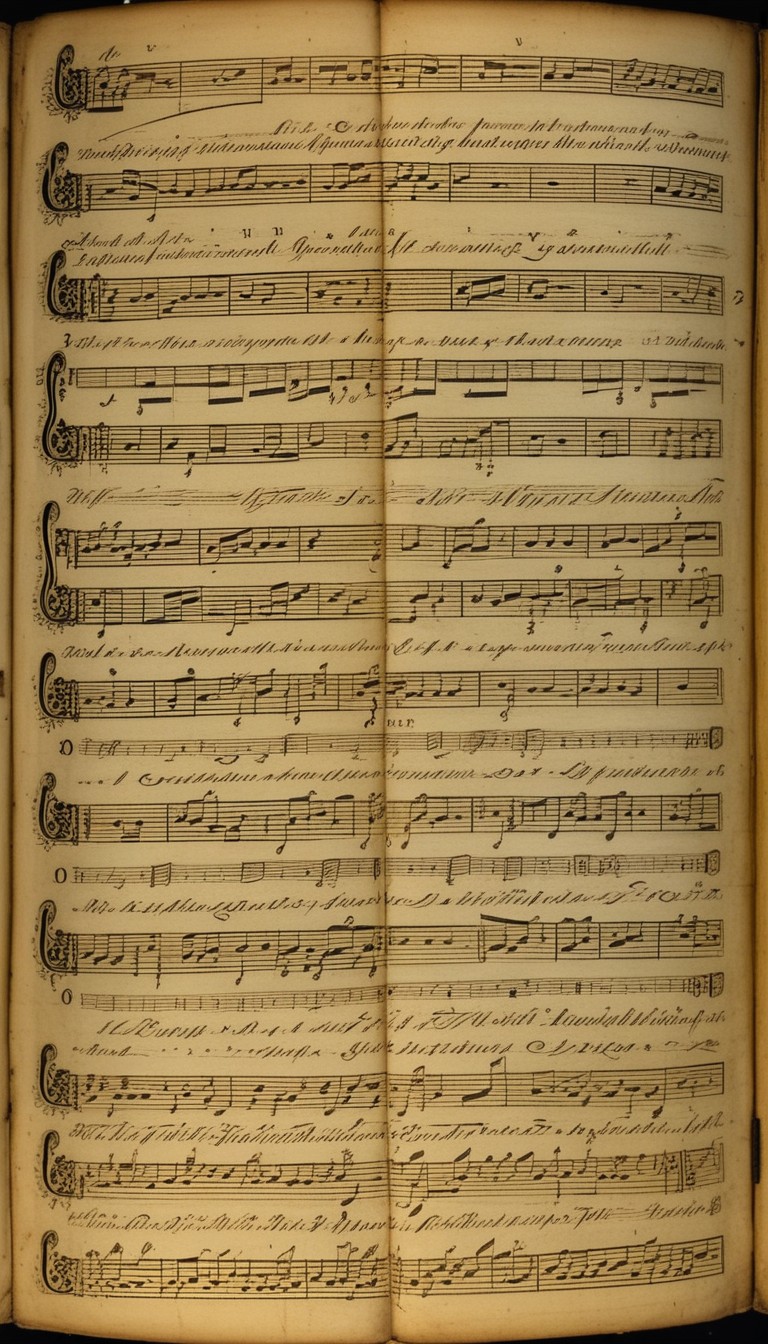
Handwritten manuscript pages covered in mathematical notation, diagrams, and annotations
1842–1843 London, England

Note G — The First Computer Program

In 1842, Italian mathematician Luigi Menabrea published a paper in French describing the Analytical Engine based on a lecture by Babbage. Ada undertook to translate it into English. Babbage suggested she add her own notes; her annotations grew to more than twice the length of the original. The seventh and final annotation, known as Note G, contained a step-by-step algorithm for computing Bernoulli numbers using the Analytical Engine—the first published algorithm ever specifically designed to be carried out by a machine. It is recognized today as the world's first computer program. Ada also introduced the concept of looping: using a sequence of instructions repeatedly, a fundamental principle of all programming that followed.
A woman writing at a desk, surrounded by musical scores, scientific instruments, and mathematical papers, gazing out a window
1843 London, England

A Vision Beyond Mathematics

Ada's most striking contribution was not the algorithm itself but the conceptual leap she made in framing it. She wrote that the Analytical Engine "might act upon other things besides number," proposing that if objects could be given symbolic representation, the machine could compose elaborate pieces of music, produce graphics, and carry out any operation reducible to a rule-based process. She distinguished clearly between the machine's ability to originate something and its ability to do only what it was instructed—anticipating debates about artificial intelligence by more than a century. She imagined, in the 1840s, that a machine could be a tool for any intellectual discipline, not merely arithmetic.
A woman resting in a sickbed, family gathered around her, afternoon light falling through tall windows
November 1852 London, England

Illness and Early Death at Thirty-Six
Ada Lovelace's health was precarious throughout her adult life. She suffered recurring bouts of illness from childhood, and the years following publication of her notes were marked by increasing pain. In the early 1850s she was diagnosed with uterine cancer. She died on November 27, 1852, at the age of thirty-six—the same age at which her father Lord Byron had died, a fact that struck many who knew her. At her own request she was buried beside Byron in the Church of St. Mary Magdalene in Hucknall, Nottinghamshire. Her work was largely forgotten in the decades that followed.
Mid-century engineers working with early electronic computers, a portrait of Ada Lovelace visible on the wall behind them
1950s–1970s United Kingdom

Rediscovery in the Twentieth Century

For nearly a century, Ada Lovelace's notes were a historical curiosity. When Alan Turing published his landmark 1950 paper "Computing Machinery and Intelligence," he cited her work directly—she was one of the few historical figures he engaged with in framing his ideas about machine intelligence. In 1953 her notes were republished, bringing them to the attention of the computing community at the dawn of the electronic computer age. Historians of computing began to recognize that her conceptual framework had anticipated the stored-program computer with remarkable accuracy. She was not simply a translator; she had been a theorist of what computation could become.
The Ada programming language reference manual alongside a portrait of Ada Lovelace

Her Name Lives in Every Line of Code

In 1980, the United States Department of Defense completed development of a new general-purpose programming language intended to replace the hundreds of incompatible languages then in use across its systems. They named it Ada—after Augusta Ada Lovelace. It was a fitting tribute: the language was designed for reliability, precision, and safety-critical systems, values that matched the rigor Ada had brought to her own work more than a century earlier. Today, Ada Lovelace Day is celebrated each October as an international day honoring women in science, technology, engineering, and mathematics. The woman who saw the future of computing in a machine that was never built remains one of the most visionary minds in the history of science.

Recommended Reading

As an Amazon Associate, we earn from qualifying purchases.
Swipe to navigate